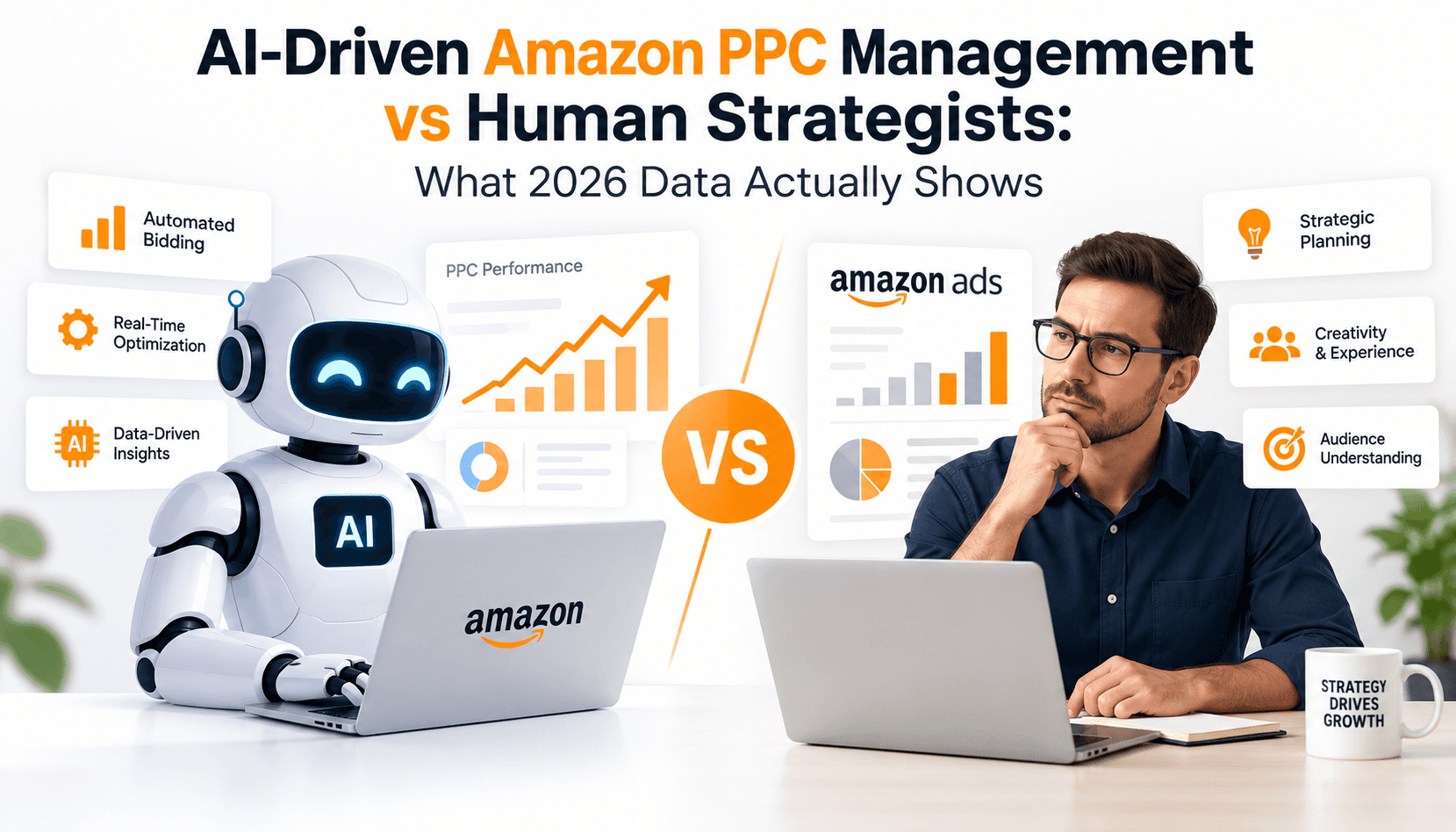
Amazon advertising has changed significantly in 2026. Artificial intelligence is no longer simply a tool for analysing campaign reports or suggesting bid adjustments. Amazon is increasingly integrating AI into campaign creation, targeting, optimisation, audience selection and shopping experiences.
This has created an important question for Amazon sellers: should you rely on AI-driven Amazon PPC management, a human PPC strategist, or a combination of both?
The answer is more nuanced than simply choosing one over the other. AI can process enormous amounts of campaign data and automate repetitive optimisation tasks at a speed that humans cannot match. However, experienced strategists bring commercial judgement, market understanding and the ability to interpret circumstances that data alone may not explain.
For UK Amazon sellers, understanding where each approach performs best is becoming increasingly important.
What Is AI-Driven Amazon PPC Management?
AI-driven Amazon PPC management uses artificial intelligence, machine learning, automation and performance data to manage different aspects of Amazon advertising campaigns.
Depending on the platform or software being used, AI can help with:
Keyword and product targeting
Bid adjustments
Budget allocation
Campaign structure
Performance analysis
Search-term analysis
Audience recommendations
Campaign pacing
Identifying optimisation opportunities
Amazon itself has expanded its AI capabilities considerably. Its Ads Agent, for example, can help advertisers create campaigns, optimise campaign settings, make targeting recommendations and work with Amazon Marketing Cloud data. Amazon states that 65% of its beta advertisers saw delivery improvements from Ads Agent's targeting recommendations, with average reductions of 18% in CPM and 16% in CPA.
This demonstrates that AI is moving beyond basic automation and becoming part of the strategic advertising workflow.
How AI Is Changing Amazon PPC in 2026
One of the biggest advantages of AI Amazon PPC management is the ability to process campaign information continuously.
A human strategist may review campaign data several times a week, whereas an automated system can monitor changes across thousands of keywords, products and campaigns much more frequently.
Amazon's Ads Agent can now assist with campaign creation, pacing, delivery adjustments and targeting recommendations. It can also generate SQL queries for Amazon Marketing Cloud, helping advertisers turn complex questions into usable analysis more quickly.
Amazon has also introduced AI-powered targeting assistance in its UK advertising environment. Advertisers can use Ads Agent to generate keyword, audience and category suggestions based on campaign objectives.
This makes AI Amazon PPC management particularly valuable for large accounts where manual campaign administration can become time-consuming.
However, speed does not automatically equal better strategy.
Where Human Amazon PPC Strategists Still Have an Advantage
A skilled PPC strategist does more than adjust bids.
They consider the wider commercial situation surrounding an Amazon account, including:
Product margins
Inventory availability
Seasonal demand
Competitor activity
Pricing changes
Product lifecycle
Promotional strategy
Brand positioning
Business growth targets
Imagine a product suddenly experiences a 30% increase in advertising costs. An automated system might reduce bids because efficiency has declined.
A human strategist may investigate further and discover that the product has just entered a highly competitive seasonal period, competitors have increased their bids, or the brand is intentionally prioritising market share.
That distinction matters.
This is where AI vs human Amazon PPC management becomes less about replacing people and more about deciding which responsibilities should be automated and which should remain under human control.
AI vs Human Amazon PPC Management: A Practical Comparison
When comparing AI vs human Amazon PPC management, there are several important differences.
Area | AI | Human Strategist |
Data processing | Extremely fast | Slower |
Repetitive optimisation | Excellent | Time-consuming |
Large campaign accounts | Highly scalable | Requires more resources |
Bid adjustments | Strong | Strong |
Pattern detection | Excellent | Good |
Commercial judgement | Limited | Excellent |
Brand strategy | Limited | Strong |
Market interpretation | Limited | Strong |
Creative decision-making | Developing | Strong |
Handling unexpected situations | Limited | Strong |
The best approach is therefore not necessarily to choose one over the other.
Instead, brands can use AI to handle repetitive, data-heavy work while allowing human strategists to concentrate on decisions that require context and judgement.
What the 2026 Data Really Tells Us
The available 2026 evidence suggests that AI can improve efficiency, but it does not prove that fully autonomous PPC management is always superior.
Amazon's own Ads Agent data is particularly interesting. The company reports that 65% of beta advertisers experienced delivery improvements from targeting recommendations, alongside average reductions in CPM and CPA. However, Amazon also describes the system as collaborative: advertisers review recommendations and retain control over proposed changes.
That distinction is important.
Amazon is effectively positioning AI as an assistant rather than removing humans from the decision-making process altogether.
Amazon Drona provides another example. Designed for agencies managing Amazon Sponsored Ads, it offers AI-based recommendations, bulk optimisation and automation. It can support monitoring across thousands of advertisers and automate changes across large numbers of accounts.
For an amazon ppc management agency, these capabilities can significantly improve operational efficiency.
Instead of spending hours making repetitive campaign changes, specialists can use automation to complete routine tasks and spend more time on strategy, analysis and client objectives.
The Biggest Strength of AI: Scale
The strongest argument for AI-driven Amazon PPC management is scale.
Consider an account with hundreds of campaigns, thousands of keywords and multiple products.
A human team can manage such an account, but reviewing every data point manually is inefficient. AI can identify patterns, flag anomalies and make large-scale recommendations much faster.
This becomes particularly useful when:
Multiple marketplaces are being managed
Campaign numbers are increasing
Product catalogues are large
Bid changes are frequent
Budgets need continuous monitoring
Search-term data is extensive
AI can therefore reduce the amount of manual work required to maintain campaign performance.
The Biggest Strength of Humans: Context
The greatest advantage of a human strategist is context.
An AI system can identify that sales have decreased. A strategist can investigate why.
Perhaps a competitor launched a new product. Maybe stock is running low. Perhaps the listing has lost organic visibility. It could even be a pricing issue rather than an advertising issue.
An experienced amazon ppc management agency can connect advertising performance with wider Amazon business factors.
That is particularly important because PPC should not be treated as an isolated activity. Advertising influences sales velocity, visibility, keyword performance and overall marketplace growth.
Why Businesses Should Not Fully Depend on Automation
Automation can make mistakes when the underlying assumptions are wrong.
For example, an AI system may decide to reduce spending on a campaign because its recent ROAS has declined. But if that campaign is supporting an important product launch, seasonal promotion or new-market expansion, reducing spend could work against the brand's larger objective.
This is why AI-driven Amazon PPC management works best when clear business rules and human oversight are involved.
Automation should execute decisions efficiently, but strategic priorities should still be defined by people.
A Hybrid Approach Is Becoming the Strongest Model
The future of Amazon advertising is unlikely to be purely AI or purely human.
Instead, AI vs human Amazon PPC management is increasingly becoming a question of collaboration.
A hybrid model can divide responsibilities intelligently.
AI can handle:
Bid monitoring
Budget pacing
Large-scale data analysis
Search-term identification
Performance alerts
Routine optimisation
Campaign recommendations
Repetitive account changes
Human strategists can handle:
Overall PPC strategy
Budget planning
Product prioritisation
Competitive analysis
Promotional decisions
Margin considerations
Marketplace expansion
Brand positioning
Interpreting unusual performance changes
This model combines the speed of technology with the judgement of experienced PPC professionals.
What This Means for Amazon Sellers in the UK
For UK sellers, the growing adoption of AI means PPC management is becoming more sophisticated.
Amazon's AI developments are also changing the shopping experience itself. In 2026, Amazon has continued expanding AI-powered shopping experiences, including conversational discovery and personalised product guidance.
That means advertisers need to think beyond individual keyword bids.
Successful Amazon advertising increasingly requires an understanding of customer intent, product relevance, campaign structure and the relationship between paid and organic visibility.
For smaller sellers, automation can provide valuable efficiency without requiring a large internal PPC team. For larger brands, combining technology with experienced strategic oversight can help manage complexity at scale.
How eStore Factory Approaches Amazon PPC
At eStore Factory, the objective should not simply be to automate as many tasks as possible.
Effective PPC management requires a balance between technology, data and human expertise.
An AI-driven Amazon PPC management approach can help identify opportunities and handle repetitive optimisation, while experienced specialists can evaluate those insights against commercial objectives.
This approach allows brands to benefit from automation without treating AI recommendations as unquestionable decisions.
For businesses considering an amazon ppc management agency, the key question should therefore not be whether the agency uses AI.
A better question is: how effectively does the agency combine AI capabilities with human strategy?
The Future of Amazon PPC Management
The role of AI in Amazon advertising will almost certainly continue to expand.
Amazon is already using AI for campaign recommendations, targeting, optimisation and analytics. Its advertising ecosystem is moving towards increasingly automated and conversational workflows.
But the evidence available in 2026 does not suggest that human expertise has become irrelevant.
Instead, AI Amazon PPC management is likely to become the operational layer that handles speed, scale and repetitive analysis, while human specialists provide direction and judgement.
Ultimately, AI vs human Amazon PPC management is not a simple battle where one side replaces the other.
The strongest Amazon advertising strategy is likely to combine both.
AI can process more information, identify patterns faster and automate repetitive tasks. Humans can understand business priorities, interpret market conditions and make strategic decisions.
For brands that want sustainable Amazon growth, AI-driven Amazon PPC management combined with experienced human oversight offers a more balanced route than relying exclusively on either technology or manual management.
Final Takeaway
The 2026 data points towards a clear conclusion: AI is becoming an increasingly powerful part of Amazon PPC, but it is not a complete replacement for strategic expertise.
AI-driven Amazon PPC management can deliver speed, scale and automation, while human strategists provide context, commercial judgement and long-term direction.
For Amazon sellers, the winning formula is not necessarily AI versus humans.
It is AI plus humans — using technology to make PPC management faster and smarter while keeping experienced professionals responsible for the decisions that matter most.
FAQS
1. What is AI-driven Amazon PPC management?
AI-driven Amazon PPC management uses artificial intelligence, automation and campaign data to optimise bids, budgets, targeting and overall advertising performance more efficiently.
2. Is AI-driven Amazon PPC management better than human PPC management?
AI-driven Amazon PPC management can process large amounts of data faster, while human strategists provide commercial judgement and strategic direction. A hybrid approach can combine the strengths of both.
3. How does AI Amazon PPC management work?
AI Amazon PPC management analyses campaign performance, search terms, bids, budgets and other advertising signals to identify optimisation opportunities and automate repetitive PPC tasks.
4. Should I hire an amazon ppc management agency that uses AI?
Yes, provided the agency combines AI tools with experienced human specialists. The technology can improve efficiency, while experts can make strategic decisions based on your products, competition, margins and business goals.
5. What is the difference between AI vs human Amazon PPC management?
AI can analyse data and perform repetitive optimisation at scale, whereas human strategists are better suited to understanding market conditions, brand objectives, product margins and unexpected changes.
6. Can AI completely replace Amazon PPC managers?
Not necessarily. AI can automate many PPC tasks, but human oversight remains valuable for strategic planning, interpreting complex situations and aligning advertising with wider business objectives.