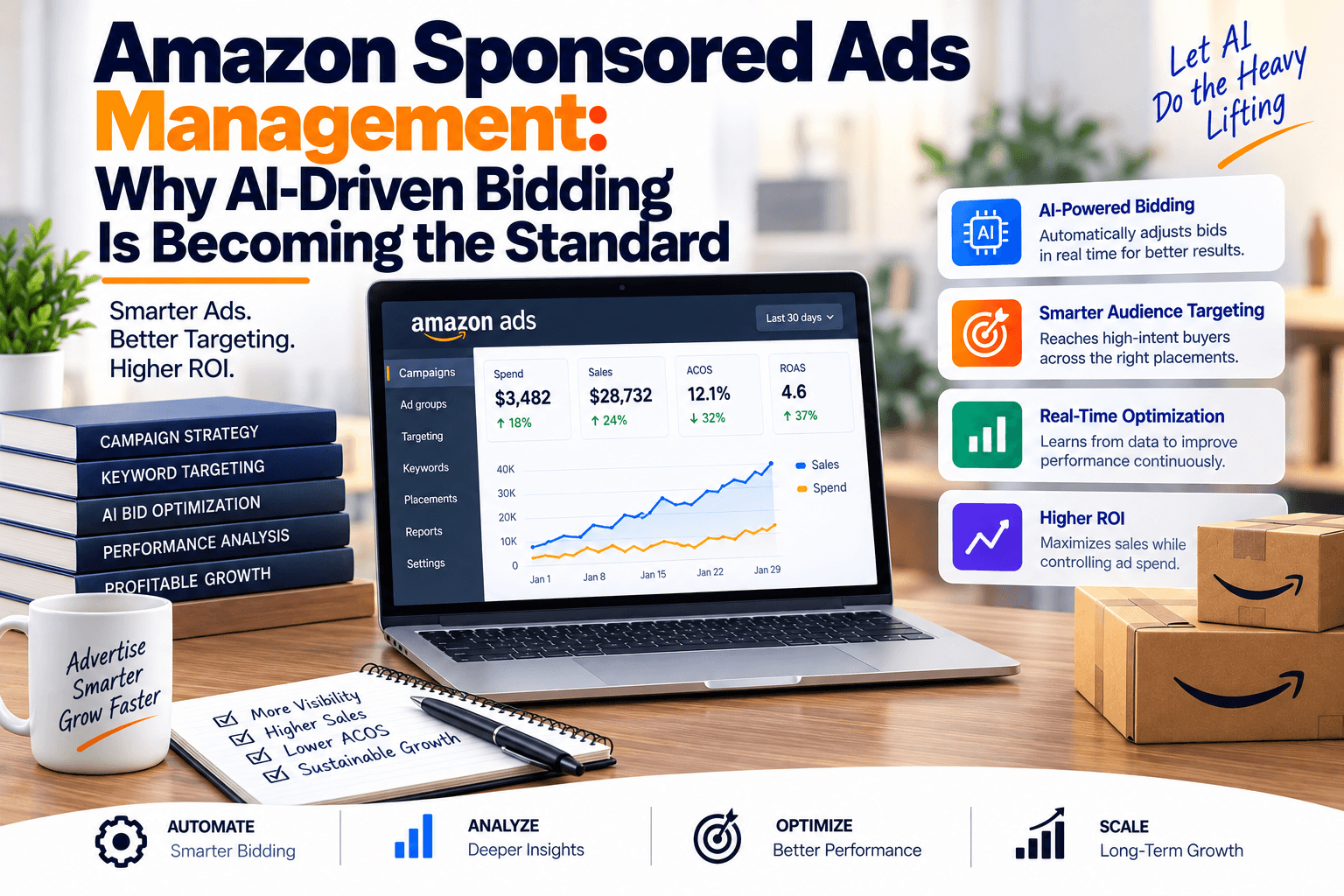
Amazon advertising has become an increasingly important part of selling successfully on the marketplace. As competition grows across categories, sellers need more than strong products and optimised listings. They also need advertising campaigns that can respond to changes in customer behaviour, keyword performance, competition, and conversion rates.
This is where Amazon Sponsored Ads Management is evolving. Traditional PPC management often involves manually reviewing campaigns, adjusting bids, analysing search terms, and controlling budgets. While these activities remain important, managing them entirely by hand can become difficult as an account grows.
AI-driven advertising introduces another approach. Instead of relying only on fixed bidding rules or occasional manual adjustments, modern systems can analyse large amounts of campaign data and automate repetitive decisions. For Amazon sellers managing multiple campaigns and products, this can make PPC management more responsive and scalable.
For businesses working with an experienced Amazon agency such as eStore Factory, AI-driven tools can also complement human strategy rather than replacing it.
What Is Amazon Sponsored Ads Management?
Amazon Sponsored Ads Management involves planning, launching, monitoring, and optimising advertising campaigns on Amazon.
Depending on the advertising strategy, this may include:
Campaign structure and targeting
Keyword research and selection
Bid management
Budget allocation
Search-term analysis
Negative keyword management
Placement optimisation
ACoS and ROAS monitoring
Campaign performance reporting
Product-level advertising analysis
Amazon offers several advertising formats, including Sponsored Products, Sponsored Brands, and Sponsored Display. Each can serve different objectives within an overall advertising strategy.
For smaller accounts, sellers may be able to handle many of these activities manually. However, as the number of products, campaigns, keywords, and marketplaces increases, the amount of data requiring attention can become substantial.
This is one reason AI-driven automation is becoming increasingly relevant to modern Amazon PPC management.
Why Traditional Bid Management Can Become Difficult
Manual PPC management gives sellers direct control, but it can also be time-consuming.
Imagine an account with hundreds of keywords. A seller may need to monitor clicks, conversions, CPC, spend, sales, and ACoS before deciding whether an individual bid should be increased, decreased, or left unchanged.
The challenge is not simply making one decision. It is making potentially hundreds of decisions repeatedly while market conditions continue changing.
A keyword that performs well today may perform differently next week. Competition can change, search behaviour can shift, and seasonal demand can affect conversion rates.
Fixed rules can automate some of this work. For example, a seller might create a rule that lowers a bid when ACoS exceeds a particular threshold.
However, a single rule does not necessarily understand the wider context behind the change.
AI-driven systems take a more data-focused approach by analysing performance patterns and using those signals to support automated bidding decisions.
How AI-Driven Amazon Advertising Works
AI-driven Amazon advertising uses automation and data analysis to help make advertising decisions at scale.
Instead of looking at one metric in isolation, an AI-driven system can process multiple campaign signals. Depending on the platform, these may include historical performance, search-term activity, conversion patterns, spending behaviour, and other campaign-level information.
The basic process can be understood as:
Collect data → Analyse performance → Identify patterns → Adjust bids or budgets → Monitor results → Optimise again
This creates a continuous optimisation cycle.
The important point is that AI does not eliminate the need for advertising strategy. Sellers still need to define business goals, understand margins, choose appropriate products to advertise, and determine what success looks like.
AI can help automate repetitive execution while human expertise remains important for strategic decisions.
The Role of Amazon Sponsored Products
Amazon Sponsored Products remain an important part of many Amazon advertising strategies because they can place individual products in relevant shopping environments.
Advertisers can target relevant keywords or products and compete for advertising placements based on their campaign settings and bids.
Effective Sponsored Products management involves more than simply increasing bids.
A campaign may require:
Relevant keyword targeting
Appropriate match types
Search-term analysis
Negative keyword optimisation
Bid adjustments
Budget control
Placement analysis
Conversion monitoring
AI automation can assist with repetitive parts of this process, particularly when an account contains a large number of campaigns and targets.
Amazon itself also provides dynamic bidding options for Sponsored Products, demonstrating the broader shift toward more responsive bidding within Amazon advertising.
AI Bidding vs. Manual PPC Management
The difference between manual and AI-assisted bidding is primarily about how decisions are made and how frequently they can be executed.
With manual management, an advertiser reviews performance and decides what action to take.
With automated bidding, software can monitor campaign information continuously and execute predefined or goal-based actions.
A simplified comparison looks like this:
Manual Management | AI-Assisted Management |
Human reviews performance | Software continuously monitors data |
Bid changes are made manually | Bid changes can be automated |
Requires regular campaign checks | Automation can handle repetitive checks |
Scaling can increase workload | Automation can handle larger data volumes |
Decisions depend heavily on manual analysis | Decisions can use multiple performance signals |
Neither approach removes the need for strategy.
The most practical model for many businesses is often a combination of automation and human oversight. AI can manage repetitive operational work while an experienced team focuses on campaign structure, product strategy, profitability, and broader Amazon growth.
Why AI-Driven Bidding Is Becoming More Relevant
One major reason is scale.
A seller managing five campaigns may be able to review performance manually. A seller managing hundreds of campaigns across multiple products and marketplaces faces a very different workload.
AI-driven systems can process large volumes of data much faster than a person manually reviewing spreadsheets.
Another factor is speed.
Advertising performance can change throughout the day. Waiting for a weekly review before adjusting every underperforming or high-potential keyword may mean missing opportunities or allowing inefficient spending to continue.
Automation can monitor campaigns more frequently and react according to the strategy that has been configured.
AI-driven bidding can also help reduce the repetitive nature of PPC management. Instead of spending significant time making small bid adjustments, sellers can spend more time on areas such as product launches, creative strategy, listing optimisation, pricing, inventory planning, and overall business growth.
Using BidBison for Automated Amazon PPC Management
For sellers looking to introduce more automation into their advertising workflow, BidBison is one tool worth considering.
BidBison is an Amazon PPC automation platform developed by eStore Factory. Its strategy engine allows advertisers to select an advertising objective and target ACoS, while the platform manages bids, budgets, keywords, and other PPC activities around that goal.
The platform supports Amazon advertising formats including Sponsored Products, Sponsored Brands, Sponsored Display, and Sponsored TV. Its features include automated bid and budget management, search-term harvesting, negative keyword handling, dayparting, reporting, and proactive alerts.
One useful aspect is its goal-based approach. Rather than requiring advertisers to build every automation rule themselves, BidBison offers strategies designed around objectives such as maintaining ACoS, scaling winning campaigns, reducing ACoS, launching products, or clearing stock.
For businesses already working with eStore Factory, BidBison can also form part of a broader PPC management workflow, combining automated campaign execution with specialist oversight.
AI Does Not Replace Amazon PPC Strategy
It is important not to treat AI as a complete replacement for human expertise.
A bidding system can analyse campaign data, but it does not automatically understand every business consideration.
For example, a seller may have a new product with a temporary advertising objective that differs from its established products. Another brand may be willing to accept a higher ACoS during a launch period to generate visibility.
Business goals, profit margins, inventory levels, product lifecycle, promotional activity, and brand strategy can all influence advertising decisions.
That is why effective Amazon PPC management should combine automation with clear commercial objectives.
AI should support decision-making and execution rather than encouraging sellers to switch campaigns to automation without understanding their goals.
What Sellers Should Look for in AI PPC Automation
Before adopting an AI-driven advertising platform, sellers should consider several factors.
1. Goal-Based Optimisation
The platform should allow you to define what you are trying to achieve rather than simply changing bids without context.
2. Bid and Budget Controls
Look for automation that can manage both bids and budgets while still allowing appropriate human control.
3. Search-Term Intelligence
Understanding which shopper search terms generate meaningful results is important for discovering opportunities and reducing wasted spend.
4. Clear Reporting
Automation should not become a black box. Sellers should be able to understand campaign performance and see what changes are being made.
5. Human Oversight
Even highly automated campaigns benefit from strategic review. Automation should support your PPC team rather than remove accountability.
The Future of Amazon Sponsored Ads Management
The future of Amazon Sponsored Ads Management is likely to involve a combination of automation, data analysis, and human strategy.
As advertising accounts become more complex, manually adjusting every bid may become less practical. AI-driven systems can handle repetitive decisions at scale while advertisers focus on higher-level commercial questions.
For sellers, the objective should not simply be to automate everything. The goal is to create a PPC system where technology handles repetitive optimisation while experienced Amazon professionals remain responsible for strategy and business context.
eStore Factory combines Amazon advertising expertise with technology such as BidBison to help sellers approach PPC management with greater automation and visibility.
Final Thoughts
AI-driven bidding is changing how sellers approach Amazon advertising. Instead of relying entirely on manual bid adjustments or static rules, businesses can use automated systems to analyse campaign data and respond to changing performance patterns.
For growing Amazon accounts, this can make advertising management more scalable and reduce the amount of repetitive work involved in day-to-day PPC optimisation.
However, successful advertising still starts with the fundamentals: relevant products, strong listings, appropriate targeting, realistic profitability goals, and a clear advertising strategy.
The most effective approach is not necessarily AI versus humans. It is often AI handling repetitive, data-heavy tasks while experienced professionals focus on strategy, commercial goals, and long-term growth.
For sellers looking to modernise their Amazon PPC management, combining intelligent automation with expert oversight can provide a practical path toward more structured and scalable advertising.
FAQs
1. What is Amazon Sponsored Ads Management?
Amazon Sponsored Ads Management involves planning, monitoring, and optimising Amazon advertising campaigns, including keyword targeting, bids, budgets, search terms, and campaign performance.
2. How does AI-driven Amazon advertising work?
AI-driven Amazon advertising uses campaign data and performance signals to automate or support decisions such as bid adjustments, budget management, and keyword optimisation.
3. What are Amazon Sponsored Products?
Amazon Sponsored Products are pay-per-click ads that promote individual product listings within Amazon’s shopping results and product pages.
4. Can AI improve Amazon PPC management?
AI can help make Amazon PPC management more scalable by automating repetitive tasks, analysing large volumes of campaign data, and responding to changing performance signals.
5. What is BidBison used for in Amazon advertising?
BidBison is an Amazon PPC automation platform that can help manage bids, budgets, keywords, search terms, and campaign strategies using automated optimisation.