
TL;DR
Most UK sellers lose sales because their Brand Store acts like a passive catalogue instead of a guided, conversion-focused landing page.
UK shoppers compare more brands, rely heavily on visuals, and buy faster when navigation is clear, making Brand Store optimisation essential.
An optimised Brand Store increases dwell time, trust, and AOV, while reducing drop-offs and preventing competitors from stealing paid traffic.
Strong layouts, seasonal blocks, lifestyle product photography, and USP tiles tailored for UK expectations significantly boost conversions.
Brand Store Insights reveal shopper behaviour, helping sellers refine layouts, improve messaging, and route traffic to the highest converting pages.
When optimised, a Brand Store becomes a sales engine that drives higher rankings, stronger ROAS, and measurable long-term growth for UK sellers.
If you have ever wondered why your Amazon UK sales are not climbing even after brand registration, here is the uncomfortable truth: your Brand Store is probably costing you money. Not because it looks bad, but because it is working like a passive catalogue when it should be acting as your highest converting landing page.
This is exactly why learning how to optimise the Amazon Brand Store becomes a turning point for most sellers. The Amazon product page is crowded, noisy, and full of competitor ads waiting to steal the shopper you paid for. One click, and they are gone. Sellers who rely only on product pages often hit a ceiling without realising why.
Your Brand Store is the only space on Amazon where you have complete control over the customer journey. No competitor ads, no distractions, no algorithm deciding what the shopper sees next. When it is optimised, it becomes a conversion engine. When ignored, it silently leaks sales every single day.
In this blog, we will break down why UK shoppers behave differently, why optimised Brand Stores consistently drive higher sales, and the exact steps top sellers take to turn their store into a predictable revenue driver.
How optimised Brand Stores drive more sales in the UK market
A Brand Store is not just a visual showcase; it also works as a conversion engine for UK shoppers. Recent Amazon internal reports show that sellers with optimised Brand Stores see up to 20 to 30% higher conversion rates compared to those without one, mainly because UK buyers spend more time exploring curated content instead of bouncing back to search results.
UK customers tend to browse multiple product tabs before choosing a brand, meaning they compare faster and expect clarity. A well-optimised Brand Store gives them a clean, structured place to evaluate your products without jumping to competitors. It reduces uncertainty, builds trust, and keeps them inside your brand ecosystem longer. Studies show that Brand Stores with organised navigation can increase dwell time by 35%, which directly contributes to stronger ranking performance.
For UK buyers who prefer tidy layouts, clear value messaging, and simple navigation, a strong Brand Store acts like an internal landing page that directs them to bestsellers, bundles, or seasonal categories instantly. When shoppers are guided smoothly, average order value often rises by 10 to 15% because buyers discover more of what your brand offers.
Because UK shoppers naturally explore pages longer when they feel confident in the brand, Amazon rewards these engagement signals. Higher dwell time and better click-through paths translate into improved placement in search results, giving your entire catalogue more visibility across the marketplace.
The real shopping behaviour of UK customers
1. UK shoppers buy faster when the store feels “organised”
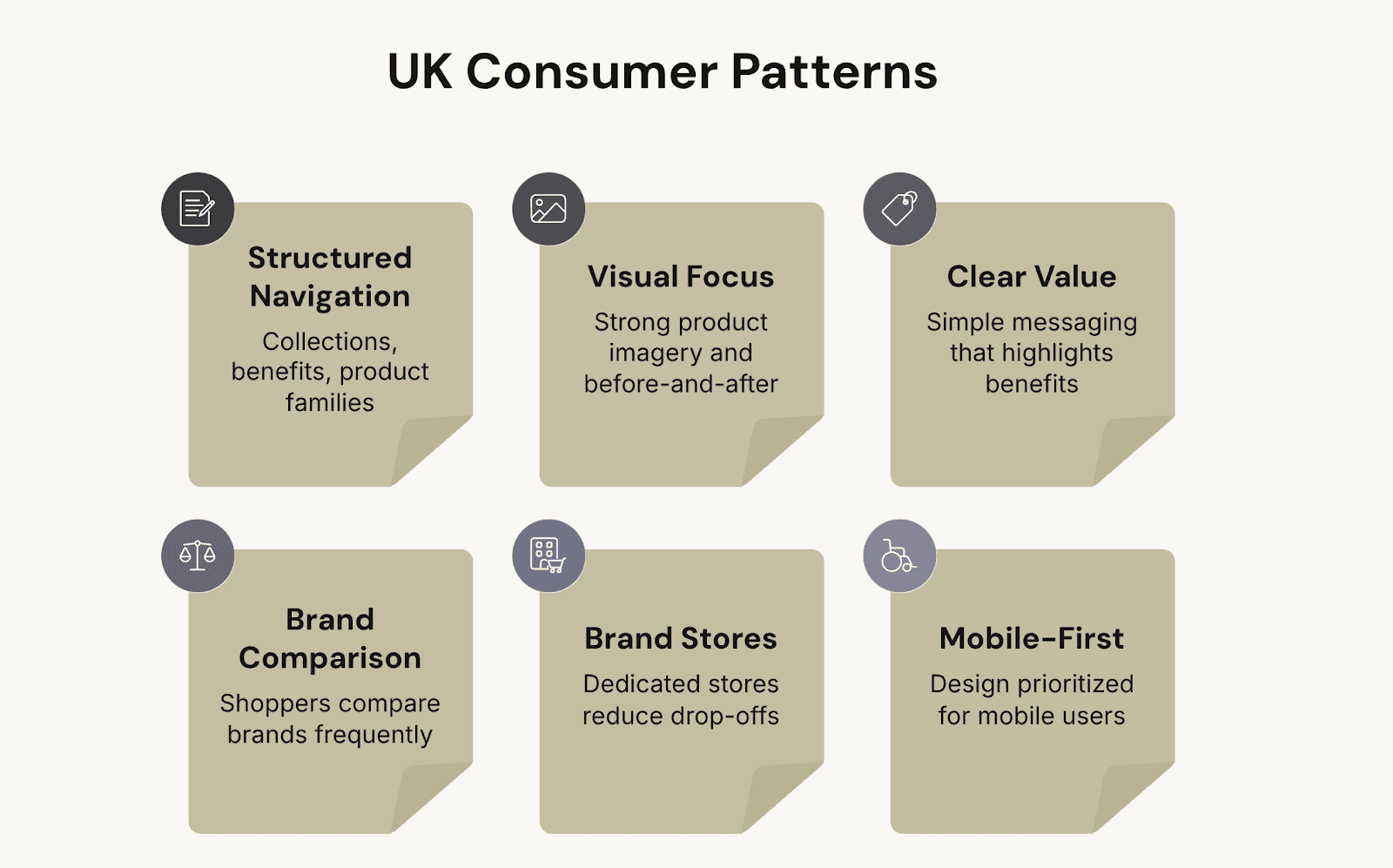
Deloitte found that 72% of UK consumers buy quickly when products are grouped clearly. This is why a messy Brand Store instantly slows conversions. When you give UK shoppers tidy collections and simple paths to follow, they move through your catalogue with confidence instead of bouncing around Amazon.
2. Visual proof matters more in the UK than in most markets
Around 65% of the decision process is driven by visuals, not text. UK shoppers want clean images, quick comparisons, and simple value cues. If your Brand Store highlights benefits visually, you instantly reduce hesitation because buyers feel they are making an informed choice.
3. UK customers compare brands aggressively
Statista reports that 58% of UK shoppers compare at least three brands before buying. That means every unnecessary click back to search is a chance to lose the sale. A polished Brand Store keeps shoppers in your world longer and cuts down the number of times they drift to competitor listings.
4. Mobile behaviour changes everything
With 75% of UK ecommerce traffic coming from mobile, shoppers judge your brand in seconds. If your Brand Store loads clean, scrolls smoothly, and presents information in short, friendly formats, they stay. If not, bounce rates spike. Optimising for mobile is no longer optional, it is the difference between a browser and a buyer.
UK consumer patterns that impact conversions
The core reason most sellers see a sales lift after fixing their Brand Store
#1 Primary ROI driver
When sellers talk about Brand Store optimisation for UK sellers, they usually think about nicer images or cleaner layouts. But the real ROI driver is much bigger. A well-built Brand Store quietly stops competitors from hijacking your traffic and keeps shoppers inside your own conversion funnel.
The most underrated advantage is the ad-free environment. The moment a shopper clicks your Sponsored Brands ad and lands on your Brand Store, every competitor ad disappears. No Sponsored Products from rival brands, no display ads pushing alternatives, nothing to distract your buyer.
For many sellers, this single change creates an immediate lift in conversions because shoppers are finally evaluating your catalogue without external noise. From there, the focus shifts to owning the funnel. Instead of letting Amazon’s algorithm decide where customers go next, you guide the shopper journey yourself.
A smart layout moves visitors from a category page to your bestseller, then into variations, and finally to the product detail page. It feels natural to the shopper, but behind the scenes, you are removing friction and reducing decision fatigue.
This setup also makes cross-selling significantly easier. With modules like “Related Products” or “Complete the Look,” you can show complementary ASINs that boost average order value. Customers who land on one product often leave with two or three because the Brand Store presents the right recommendations at the right time.
Example:
A UK skincare seller promoting a vitamin C serum noticed that once they added a simple "pair it with" module for moisturiser and sunscreen, bundle sales increased by nearly 18%. Nothing else changed; the store just started working smarter.
This is why sellers who fix their Brand Store almost always see a measurable lift in conversions and AOV. It is not about looking pretty; it is about owning the shopper path from the moment they click.
#2 Beyond internal search
Most sellers think search visibility on Amazon stops at keyword rankings, but a Brand Store opens a second layer of discoverability that many UK sellers never tap into. When you optimise Amazon Brand Store for more UK sales, you are not only improving how the shopper experiences your pages, but you are also teaching Amazon’s algorithm how to categorise your entire catalogue more accurately.
Inside the Brand Store, the navigation and search bar play a bigger role than most sellers assume. Each time a customer clicks through collections, subpages or product groups, Amazon registers those pathways as relevance signals. Over time, these signals help your full catalogue surface more often for branded and category searches, especially when customers are already inside your ecosystem.
But the real unlock is Google indexing. Unlike most Amazon pages, your Brand Store can rank on Google Search. This gives UK sellers a rare chance to capture external traffic without building a website. All you need is a strong meta description and subpages with descriptive, keyword-rich titles.
Example:
“Vitamin D Supplements UK” performs far better than a generic title like “Supplements.” Then comes the PPC advantage. Sponsored Brands and Sponsored Display ads become dramatically more efficient when routed to tailored Brand Store landing pages.
These pages convert 20 to 30% higher on average because shoppers land on curated content instead of a single product listing.
#3 Data-driven decision making
One of the biggest differences between a casual seller and a professional UK seller is how they use data. The top performers do not guess what shoppers want; they read the signals Amazon already provides and refine their Brand Store with every update.
A good starting point is the Brand Store Insights Dashboard. Most sellers look at it once and move on, but this dashboard quietly reveals which pages are doing the heavy lifting. If your skincare “Bestsellers” page gets twice the visitors but generates fewer orders than your “Vitamin C Collection,” that is a sign that your layout or messaging needs tightening. UK shoppers are fast decision-makers, so the pages they explore the most should be the pages that convert the strongest.
Next is Brand Analytics, which has become far more powerful with AI and machine learning woven into Amazon’s backend. This is where you learn the exact phrases UK customers use when they shop. Maybe they do not search for “gut health capsules,” but instead “digestive support UK.” These insights should directly influence your A+ content, your Brand Store headers, and even the modules you choose to highlight.
Then there is A/B testing, an underrated tool for optimising Brand Store performance. Testing two versions of an image banner, headline, or comparison chart can show you exactly what holds a shopper’s attention. Many UK sellers discover that shorter claims, cleaner icons, or reorganised benefit blocks outperform visually heavy designs.
The sections every high-converting Amazon UK brand store must include
1. Start with a clear hero section
UK shoppers respond best to simple, direct language. A hero banner that states your brand’s value in one clean sentence sets the tone immediately. Whether you sell wellness, home goods, or electronics, clarity wins. This first impression often decides whether a shopper continues exploring or exits.
2. Use a modular navigation structure
UK buyers move through categories quickly and dislike clutter. A clear menu with product families, collections, or use cases keeps them inside your Brand Store instead of returning to Amazon’s search results, where competitor listings appear. This structure reduces friction and improves the overall shopping journey.
3. Add a bestsellers grid for fast decision makers
Many UK shoppers rely on social proof and prefer choosing products that others already trust. Highlighting your top sellers gives them an easy starting point and often boosts conversions from visitors who want quick clarity without too many choices.
4. Include seasonal category blocks
The UK retail calendar is strongly seasonal, so dedicated blocks for Prime Day, Mother’s Day, Father’s Day, Q4 gifting, or winter essentials help guide shoppers toward relevant items. These timely sections increase product discovery and push higher intent traffic deeper into your store.
5. Show USP tiles tailored to UK expectations
UK customers pay close attention to details like accurate sizing, clear safety assurances, local compliance notes, and sustainability signals. Short USP tiles addressing these concerns help create confidence and reduce hesitation.
6. Use lifestyle images or short videos for credibility
UK buyers want to visualise how a product fits into real life. Simple lifestyle scenes, strong lifestyle product photography, or quick videos create trust and make it easier for shoppers to picture the item in their home, boosting engagement and conversions.
How Brand Store insights give UK sellers a competitive advantage?
Most Amazon UK sellers look at their Brand Store as a static showcase, but the real advantage comes from the data behind it. Store Analytics tells you exactly how customers behave inside your store, and once you understand those patterns, you can optimise every page to lift conversions.
Many sellers even ask, Does the Amazon Brand Store improve organic ranking in the UK? When the store is optimised using real shopper data, the answer is often yes, because engagement signals feed back into visibility.
One of the biggest unlocks is seeing which pages convert best. If your “Bestsellers” page drives high traffic but low orders, something in the layout or messaging is not connecting with UK shoppers. If a niche category converts better, you know where to send more traffic through ads and internal navigation.
Click insights show which tiles and products get the most attention. UK shoppers scan and click with intention. High-performing tiles reveal what resonates, while low-performing ones highlight confusion or weak messaging.
Understanding how customers move between products is even more valuable. For example, if shoppers move from a vitamin C serum to moisturisers, that is a natural cross-sell path you can design around. Drop-off metrics reveal where customers lose interest. If many visitors exit on a specific subpage, it needs refinement, whether it is in layout, images, or clarity.
When UK sellers monitor these insights regularly, the Brand Store stops being just a digital Brand Storefront and becomes a sales engine that adapts to real buyer behaviour, consistently improving performance and, in many cases, supporting better organic ranking outcomes.
Amazon Brand Store optimisation checklist for UK sellers
Pillar | Why It Matters for UK Shoppers | Key Elements to Include |
Clarity | UK shoppers prefer simple navigation and direct messaging. | Clean hero statement Organised category structure Clear product families and collections |
Trust | Confidence is a major purchase driver in the UK market. | USP tiles for sizing, safety, and compliance Lifestyle visuals that show real use Seasonal blocks aligned with UK retail cycles |
Conversion | UK buyers convert faster when guided intentionally through the store. | Prominent bestsellers grid- Cross sell and “Complete the Set” modules Sponsored Brands ads routed to curated landing pages Strong mobile layout |
Final words
If there is one thing this breakdown makes clear, it is that a Brand Store is no longer optional for Amazon UK sellers aiming for steady, predictable growth. It is your only space on Amazon where you control the journey, guide shoppers intentionally, and eliminate the distractions that kill conversions.
When you understand the real Amazon Brand Store traffic drivers UK sellers rely on, your Storefront stops being decorative and becomes a performance engine. Add data, clean navigation, and smart cross- sell logic, and your store starts lifting conversions, AOV, and organic visibility across your entire catalogue. The sellers winning today are not guessing; they are building a structure. Once you optimise your Brand Store with that mindset, your results follow.